Fuel Price Relief Expected in July and Industry Updates
Some Relief at Last: Fuel Prices Drop Heading in a Good Direction — Geopolitics and it’s Current Positive Impacts on the Industry
Fuel Price Relief Expected in July
A sharp drop in oil prices, and the rand marching towards R16/$, is putting South African businesses and motorists in line for welcome relief next month—even with the end of the fuel levy relief.
Mid-month data from the Central Energy Fund (CEF) shows significant over-recoveries for petrol and diesel for July.
Petrol price recoveries are well over R2.50 per litre, while diesel is lining up for another significant cut, with over-recoveries above R4.20 per litre.
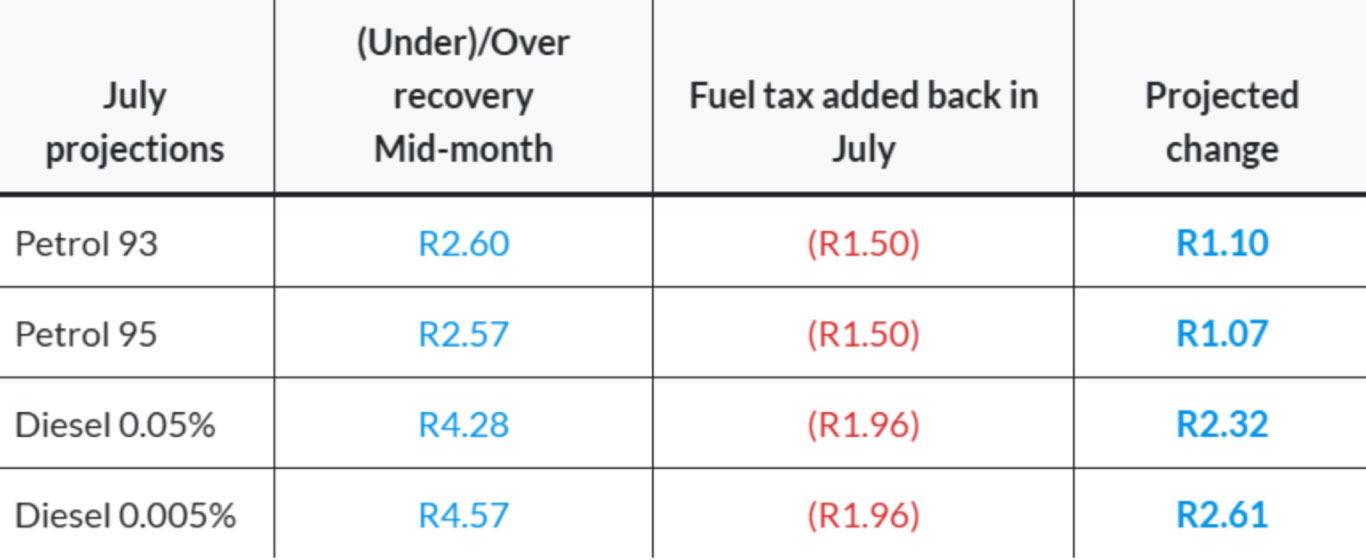
These are the recoveries at mid-month:
- Petrol 93: decrease of R2.60 per litre
- Petrol 95: decrease of R2.57 per litre
- Diesel 0.05% (wholesale): decrease of R4.28 per litre
- Diesel 0.005% (wholesale): decrease of R4.59 per litre
Typically, over-recoveries at these levels would put huge price cuts on the cards; however, the end of the National Treasury’s fuel levy relief will offset this.
After adding half the fuel levy relief back into prices in June, the fuel levy relief will fully terminate in July.
This will see R1.50 per litre be added back into petrol prices in July, with diesel prices having R1.96 per litre reintroduced.
However, even with the levies being added back, the fuel recoveries remain positive—meaning a cut at the pumps is still likely for July.
The table below outlines how the July fuel prices could be impacted by their return.
Global Oil Markets: Pressure and Politics
Global oil markets remain caught between geopolitical pressure and political uncertainty as developments in the Middle East continue to influence crude oil prices and market sentiment. While recent diplomatic efforts have eased concerns of a prolonged supply disruption, tensions in the region continue to create volatility across international energy markets. A significant development came with the signing of a memorandum of understanding between the United States and Iran, brokered by regional partners, aimed at ending hostilities and reopening the critical Strait of Hormuz to international shipping.
The agreement has helped restore confidence to energy markets and has contributed to a sharp decline in crude oil prices. Brent crude, which traded above $110 per barrel at its peak during the conflict and reached highs of approximately $113 per barrel earlier this year, has since fallen below $80 per barrel — a decline of nearly 30% from its recent high and its lowest level in more than three months.
For South Africa, these global events have a direct impact on fuel pricing, as fluctuations in crude oil prices and exchange rates influence local fuel cost recoveries. While the recent decline in oil prices is supportive of lower fuel costs heading into July, uncertainty remains as shipping activity through the Strait of Hormuz gradually returns to normal and regional political tensions persist.
As the industry moves into the second half of the year, the balance between political negotiations and market fundamentals will play a critical role in determining whether fuel prices continue to stabilize or face renewed upward pressure.