

Increasing Fuel Costs, Navigating Volatility, and Preparation for September 2026
South Africa’s fuel market is entering another period of significant uncertainty, and for businesses that rely heavily on diesel, the timing of purchases could have a meaningful impact on operating costs.
The latest market indicators suggest that September is bring another substantial increase in fuel prices, while international oil markets are becoming increasingly volatile. For wholesale diesel buyers, the message is straightforward: waiting until the end of the month to replenish stock could expose businesses to both higher prices and potential supply constraints.
What is happening in the market?
Global oil markets have turned sharply higher over the past week as uncertainty surrounding the US–Iran conflict has increased. On 20 August, Brent crude climbed to around $94 per barrel, reaching its highest level in more than three weeks and recording a fifth consecutive daily gain.
The key concern for the fuel market is not simply the price of crude oil itself, but the potential impact on refined fuel supply. The ongoing disruption in the Middle East is affecting shipping and refining activity, while oil flows through the strategically important Strait of Hormuz remain well below normal levels. This is particularly important for diesel, where global refining capacity and inventories are already under pressure.
For South Africa, this creates additional exposure because the local market is influenced by international petroleum product prices, the rand/dollar exchange rate and the Basic Fuel Price mechanism.
There is also a wider structural concern: South Africa is a net importer of diesel, making the country particularly vulnerable when international refined-product markets tighten.
In other words, the market is currently being driven by a combination of:
- Geopolitical uncertainty
- Higher international crude oil prices
- Tight refined-product markets
- Disrupted shipping and supply routes
- Rand/dollar movements
- Increasing South African fuel-price under-recoveries
This combination creates an environment where prices can move considerably in a very short period.
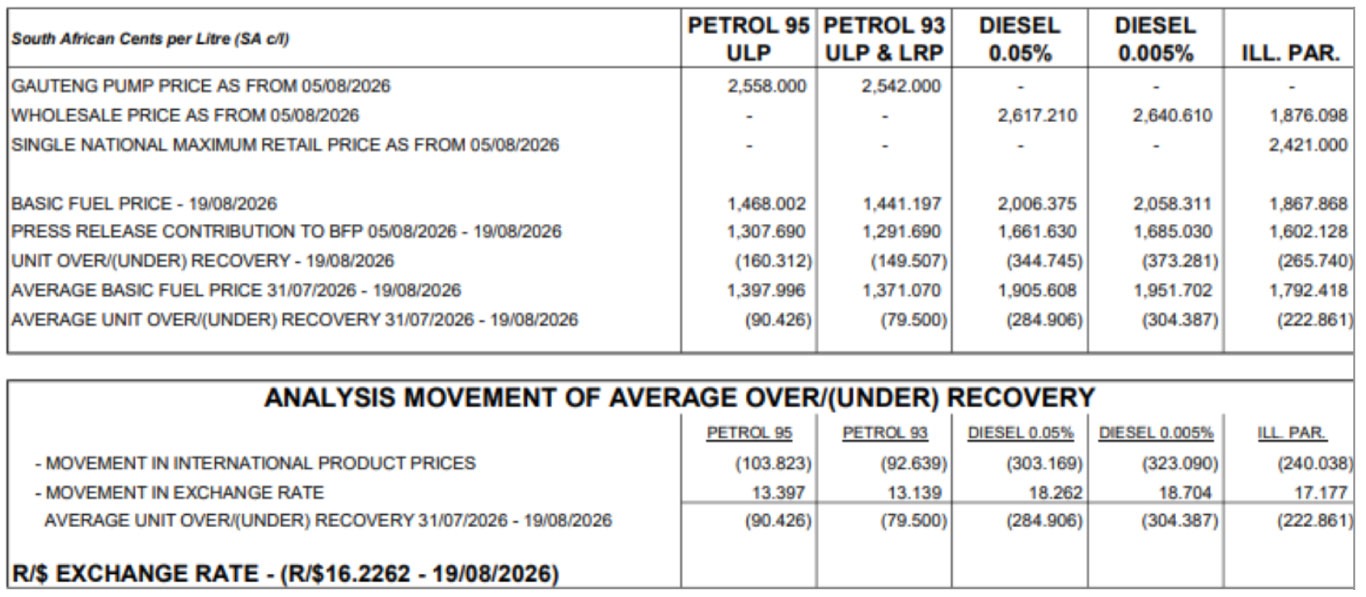
Why are prices rising – and how high could they go?
The biggest immediate concern for South African diesel buyers is the under-recovery being recorded in the fuel-price system.
An under-recovery essentially means that the current regulated fuel price does not fully compensate for the cost implied by international petroleum prices and the exchange rate. That shortfall is then reflected in the next monthly price adjustment.
Current estimates indicate that diesel is facing an under-recovery of approximately R3 per litre, although this figure can change substantially before the end of the review period.
Recent projections have placed the potential September increase at approximately:
Petrol 93 ~R0.51 to R0.90 p/l
Petrol 95 ~R0.62 to R1.04 p/l
Diesel 50PPM ~R3.00 to R3.50 p/l
These figures are projections, not final prices. The CEF calculation continues to change daily until the end of the month.
More recent daily report (see above) has also indicated a diesel increase of around R3.04/l, illustrating just how quickly the expected adjustment can move as international markets change.
Why buying before the middle of next week could be smarter
For businesses that know they will require diesel during the first part of September, waiting until the final days of August may not be the best strategy.
The obvious temptation is to continue purchasing at today’s lower price and only build additional stock immediately before the official price increase.
The problem is that many other businesses may be thinking exactly the same thing.
As the month-end approaches, demand for diesel can increase as businesses attempt to fill tanks before the price adjustment takes effect. At the same time, suppliers and distributors have to manage their own inventory, deliveries, transport capacity and replenishment schedules.
This creates a potential month-end supply bottleneck.
It does not necessarily mean that South Africa will experience an actual nationwide diesel shortage. Rather, the risk is that individual customers could encounter:
- Longer delivery lead times
- Limited delivery slots
- Suppliers prioritising existing contractual customers
- Delays caused by increased logistical demand
The safest strategy is therefore not to wait until everyone else is trying to secure the same product.
Buy before the rush
For businesses with adequate storage facilities, purchasing additional stock before the middle of next week provides several advantages.
First, it provides price protection.
If the projected September increase of roughly R3/l materialises, diesel purchased before the adjustment effectively locks in today’s lower cost.
For example:
- 5,000 litres = approximately R15,000 additional cost
- 10,000 litres = approximately R30,000
- 20,000 litres = approximately R60,000
- 50,000 litres = approximately R150,000
And that calculation is based only on the potential price adjustment — before considering any further movement in crude oil, the rand or supply premiums.
Second, it reduces exposure to further market movements.
Brent is already around $94/bbl and has risen for five consecutive sessions. If geopolitical tensions escalate further, the September increase could become larger rather than smaller.
Third, it provides supply security.
Rather than attempting to secure diesel when demand is potentially at its highest, businesses can build sufficient stock while normal supply channels are still operating.
Finally, it gives businesses flexibility.
Having fuel already in storage means purchasing decisions can be based on market conditions rather than operational necessity. You are less likely to be forced to buy at whatever price is available simply because the tank is running low.
There is therefore a real financial argument for businesses to consider bringing forward purchases where storage capacity, cash flow and operational requirements allow.
The QFS view
The current market is a good reminder that fuel purchasing should be treated as a procurement strategy, not simply an operational expense.
The market has already demonstrated how quickly conditions can change. Earlier in the year, falling oil prices created expectations of significant fuel-price reductions. Those expectations were subsequently reversed as geopolitical tensions returned. The August adjustment itself saw diesel prices increase by more than R1/l, while the outlook for September has deteriorated considerably.
Our team is ready to assist you in securing your diesel supply ahead of the September adjustment. Reach out to us today to discuss your requirements and lock in your order.