

Rising Diesel Costs, Navigating Volatility and Market Realities
The South African fuel market is currently experiencing unprecedented pressure, driven by global geopolitical tensions, currency fluctuations, and structural pricing mechanisms. As we move deeper into 2026, businesses operating in the fuel sector must prepare for continued uncertainty, rising input costs, and evolving pricing structures—particularly within the diesel market.
This newsletter outlines three critical developments shaping the industry:
Diesel Price Hikes and the Reality of Surcharges
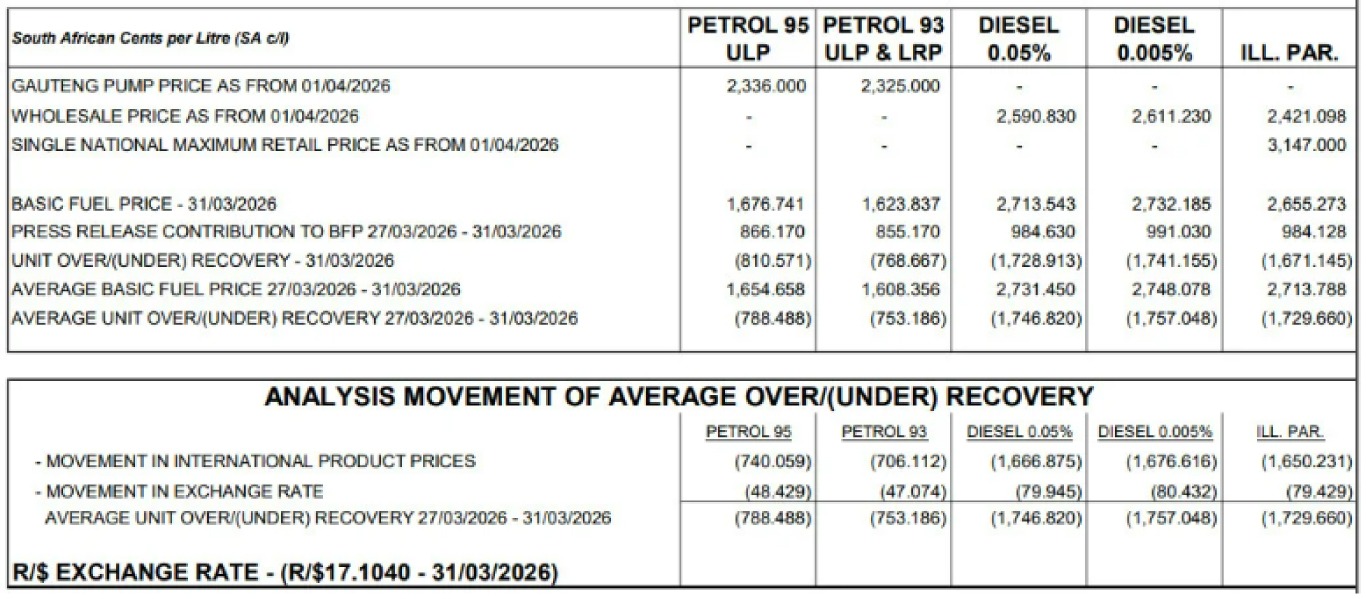
Diesel pricing has become increasingly complex due to significant under-recoveries and cost averaging across supply chains. Early data from the Central Energy Fund (CEF) suggests that diesel under-recoveries have reached levels exceeding R17 per litre.
This aligns with projections that the next fuel price adjustment (scheduled for May 2026) could result in additional increases of R10+ to R20+ per litre, depending on market conditions and government intervention.
It is important to understand that these increases are not always immediately reflected in retail or wholesale prices.
Suppliers often carry stock purchased at varying price points, which results in:
- Averaged pricing structures
- Temporary surcharges
- Lagging price adjustments
These mechanisms are necessary to maintain supply continuity but may lead to short-term price discrepancies that differ from official monthly adjustments.
Furthermore, while the government introduced a temporary R3 per litre fuel levy reduction to cushion April increases, this relief is expected to be reversed or recovered —potentially adding further upward pressure on prices.
Key takeaway:
Diesel price increases are being amplified by both market forces and structural cost recovery mechanisms—making surcharges an unavoidable reality in the current environment.
Why Diesel is Not Regulated in South Africa
- Petrol prices are regulated by the government
- Diesel prices are not fully regulated at the retail level
Diesel operates within a wholesale-based pricing framework, meaning that while elements such as the Basic Fuel Price are guided by government formulas, the final selling price is influenced by:
- Supply and demand dynamics
- Transport and logistics costs
- Storage and handling costs
- Supplier-specific margins
This partial deregulation allows diesel prices to respond more rapidly to market conditions—but also introduces variability and pricing disparities across regions and suppliers.
Recent developments have highlighted this distinction, with reports confirming that diesel prices are not strictly regulated, allowing fluctuations beyond standard government-controlled adjustments.
Key takeaway:
Diesel pricing flexibility enables market responsiveness—but also results in increased volatility and less predictability for end users.
Market Volatility Driving Fuel Instability
Global energy markets remain highly volatile, with recent geopolitical disruptions—particularly in the Middle East—placing strain on supply chains and pushing international oil prices higher. This has had a direct impact on South Africa, which relies heavily on imported refined fuel products.
Recent data indicates that these pressures are unlikely to ease in the short term. The weakening Rand and rising crude oil prices continue to drive up the Basic Fuel Price (BFP), creating persistent under-recoveries in the system.
According to recent reporting, South Africa has already experienced record increases in April, with diesel prices rising by over R7 per litre in a single adjustment cycle.
Additionally, supply chain disruptions and panic buying have contributed to localized shortages and price inconsistencies, particularly in high-demand sectors such as agriculture and logistics.
Key takeaway:
Market volatility is no longer cyclical—it is structural. Businesses should expect continued fluctuations and plan procurement strategies accordingly.