Fuel Industry News: Volatility on the Horizon Once Again as the Geopolitical Landscape Keeps Shifting
Just weeks ago, South African consumers and businesses were anticipating one of the largest fuel price decreases of 2026. Early indications suggested that August could bring relief of more than R2.00 per litre across various fuel grades as international oil prices softened following a temporary easing of tensions in the Middle East.
Fast forward to today, and the outlook has changed considerably.
Renewed geopolitical uncertainty, coupled with fluctuations in Brent crude oil prices and currency movements, have once again reminded the fuel industry just how susceptible South Africa remains to global market developments. What initially appeared to be a straightforward month of fuel price relief has rapidly evolved into another period of volatility especially for diesel consumers.
Global Markets Continue to Drive Local Prices
South Africa imports a significant portion of its refined fuel products, leaving local fuel prices heavily exposed to international supply and demand dynamics.
The fuel market remains sensitive to:
- Renewed geopolitical tensions and military developments in key oil-producing regions.
- Potential disruptions to international shipping routes.
- Brent crude oil price volatility.
- Exchange rate fluctuations between the South African Rand and US Dollar.
- International refinery production and diesel inventories.
- Growing concerns surrounding strategic fuel security in South Africa.
While many consumers tend to focus on the monthly fuel price adjustment, it is often these underlying market fundamentals that have the greatest impact on pricing trends and supply security.
August Fuel Price Predictions
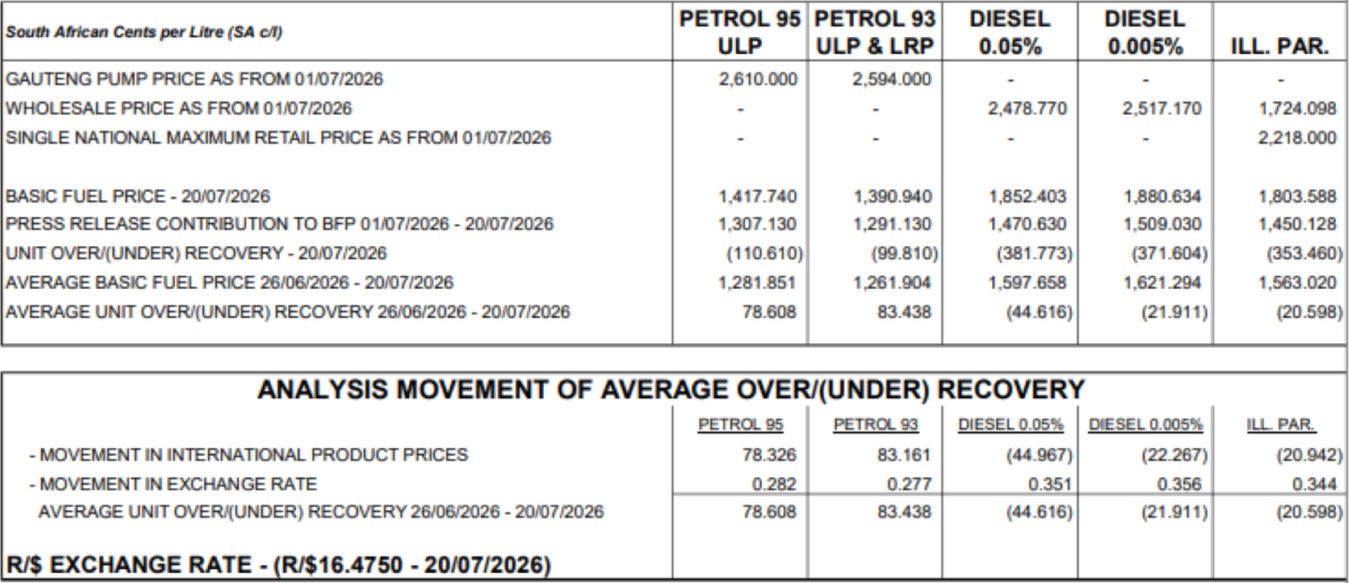
Based on the latest available market indicators and over/under recovery figures, August is still expected to bring some welcome relief for petrol users, although significantly less than originally forecast earlier this month. Diesel on the other hand took a drastic swing in the opposite direction.
QFS Predicted Fuel Product Changes – August 2026:
- Petrol 93 Decrease of 80c to R1.20 per litre
- Petrol 95 Decrease of 80c to R1.20 per litre
- Diesel 50ppm Increase of 50c up to R1.50 per litre
The diesel outlook remains particularly uncertain and is likely to remain volatile until the final fuel price calculations are released.
Unlike petrol, diesel pricing is often more susceptible to international distillate supply conditions, making it increasingly difficult to forecast with certainty during periods of geopolitical instability.
Diesel Market Showing Signs of Increased Risk
For commercial diesel consumers, price is only one part of the equation.
Over the past several years, South Africa’s refining capacity has reduced considerably, increasing the country’s reliance on imported diesel products. As a result, disruptions in international supply chains can have a much greater impact on local diesel availability than many businesses realise.
Although no major diesel shortages are currently being experienced in South Africa, industry participants continue to monitor developments closely.
Heightened geopolitical tensions have historically led to tighter supply conditions and reduced pricing flexibility within wholesale fuel markets.
Businesses operating large diesel-dependent operations—including transport fleets, mining operations, agricultural producers, manufacturing facilities and backup power installations—should consider both their pricing strategy and stockholding requirements heading into August.
What Can We Expect Going Forward?
The fuel market has become increasingly reactive to global events. Price forecasts that appeared relatively certain only a week ago can change dramatically within days.
Our expectations for the coming weeks are:
- Continued volatility in diesel pricing.
- Reduced pricing certainty across the wholesale market.
- Greater sensitivity to geopolitical developments.
- Increased importance of supply planning for commercial consumers.
- Potential pressure on diesel availability should international conditions deteriorate further.
The days of predictable month-on-month fuel price movements appear to be behind us. In today’s environment, businesses that actively monitor market developments and plan their fuel procurement strategies accordingly are often best positioned to mitigate both pricing and supply risks.
Final Thoughts
The August fuel price adjustment will still provide some relief for petrol consumers, but the diesel market remains far more uncertain than initially anticipated.
Volatility is once again on the horizon, and while no major supply disruptions are currently expected, the global geopolitical landscape continues to shift at a rapid pace. For fuel consumers across South Africa, market intelligence and forward planning have never been more important.